


Living in Panama looks simple from the outside: a dollar economy, warm weather and a short flight home. The legal side is what decides whether the move actually works, because your immigration status determines how long you can stay, whether you can work, and even how long you can drive on your US license.
Panama ranked first in the InterNations Expat Insider 2026 survey for the third consecutive year, and 82% of the expats surveyed said that obtaining a visa was straightforward. That is true when you choose the right category from the start. It is far less true when you arrive as a tourist and try to solve everything later.
This guide was prepared by the immigration attorneys at NDM Law Firm & Associates. It covers what living in Panama is really like for Americans and what the law allows you to do at each stage. If you already know you want to move, book a consultation and we will review which residency option fits your case.
Living in Panama as an American: The Basics
For an American, living in Panama starts with one practical advantage: the country uses the US dollar as legal tender, so there is no exchange risk on your savings, pension or salary. Spanish is the official language, although English is common in banking, private healthcare and the main expat areas. Direct flights connect Panama City with Miami, Houston, Atlanta and New York.
US citizens can enter without a visa and stay for up to 180 days as tourists. Canadian citizens receive the same 180 days. The details are in our guide to Panama visa requirements for US citizens.
That generous tourist stay is where many problems begin. Tourist status is not residency. It does not allow you to work for a Panamanian employer, it does not give you a local ID, and it does not count toward permanent residency or citizenship. Anyone who plans on living in Panama for more than a few months needs a residency category, and the sections below explain which one.

7 Legal Facts About Living in Panama Before You Move
These are the seven points that our attorneys explain most often to American clients during a first consultation.
- Americans can stay up to 180 days as tourists, but a tourist stamp never authorizes work.
- Panama does not issue a stand-alone work visa. Residency comes first, and the work permit comes second.
- A professional visa and a work permit are two different procedures before two different authorities.
- The Pensionado Visa grants permanent residency with a lifetime pension of at least $1,000 per month, but it does not allow local employment.
- The Friendly Nations Visa is the most common route for Americans who want to work or invest.
- A US driver’s license is valid for 90 days from entry, and that period runs separately from your immigration stay.
- Foreigners can own titled property with the same rights as Panamanian citizens, subject to limited exceptions near the national borders.
The Pros and Cons of Living in Panama
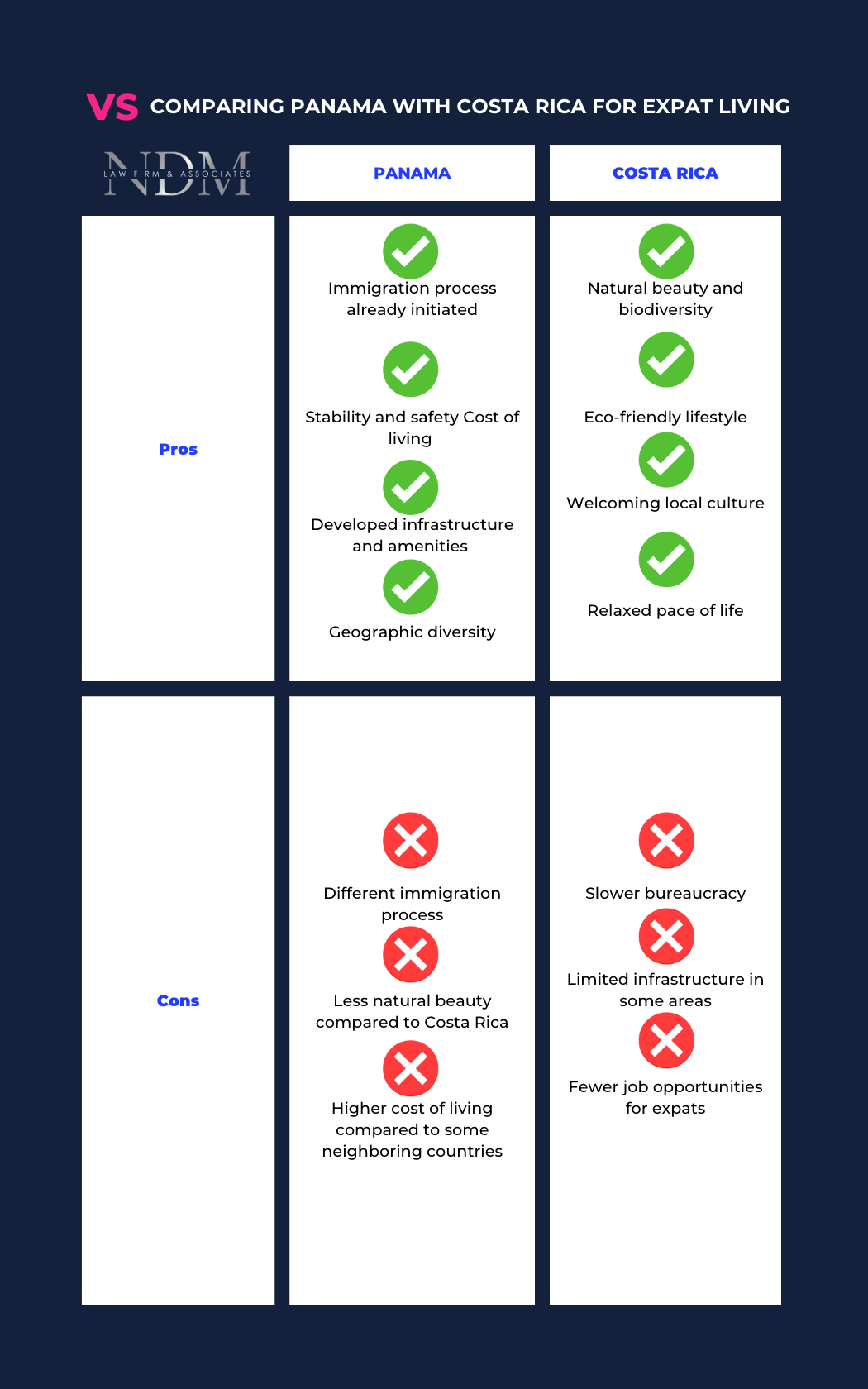
Every relocation involves trade-offs, and living in Panama is no exception. The points below are the ones our clients mention most often after their first year in the country, and several of them have a legal side that is worth understanding before you sign a lease.
Benefits of Living in Panama
- Dollar economy. Your income and your expenses are in the same currency.
- Territorial tax system. Panama taxes income generated in Panama. Foreign pensions and foreign-source income are generally outside the Panamanian tax base.
- Several residency routes. Retirees, employees, investors and remote workers each have a category designed for them.
- Private healthcare. Panama City has modern private hospitals, and consultation fees are well below US prices.
- Financial comfort. In the InterNations 2026 survey, 90% of expats in Panama said their disposable income was enough to live comfortably.
- Established expat communities. You will find English-speaking neighbors in the capital, on the Pacific beaches and in the highlands.
Disadvantages of Living in Panama
- Bureaucracy. Government procedures are slow, they are conducted in Spanish, and immigration filings must go through a licensed Panamanian attorney.
- Traffic. Panama City congestion is heavy, and the same survey ranked the country last for road infrastructure.
- Climate. Heat and humidity are constant at sea level, and the rainy season runs roughly from May to December.
- Language outside the capital. Daily life in the interior requires at least basic Spanish.
- Banking. Opening an account takes patience, reference letters and proof of the origin of your funds.
- Restricted professions. Many licensed professions are reserved by law for Panamanian citizens, which surprises Americans who expected to practice their career here.
None of these are reasons to give up on living in Panama. They are reasons to plan the move with accurate information.
Where Do Expats Live in Panama?
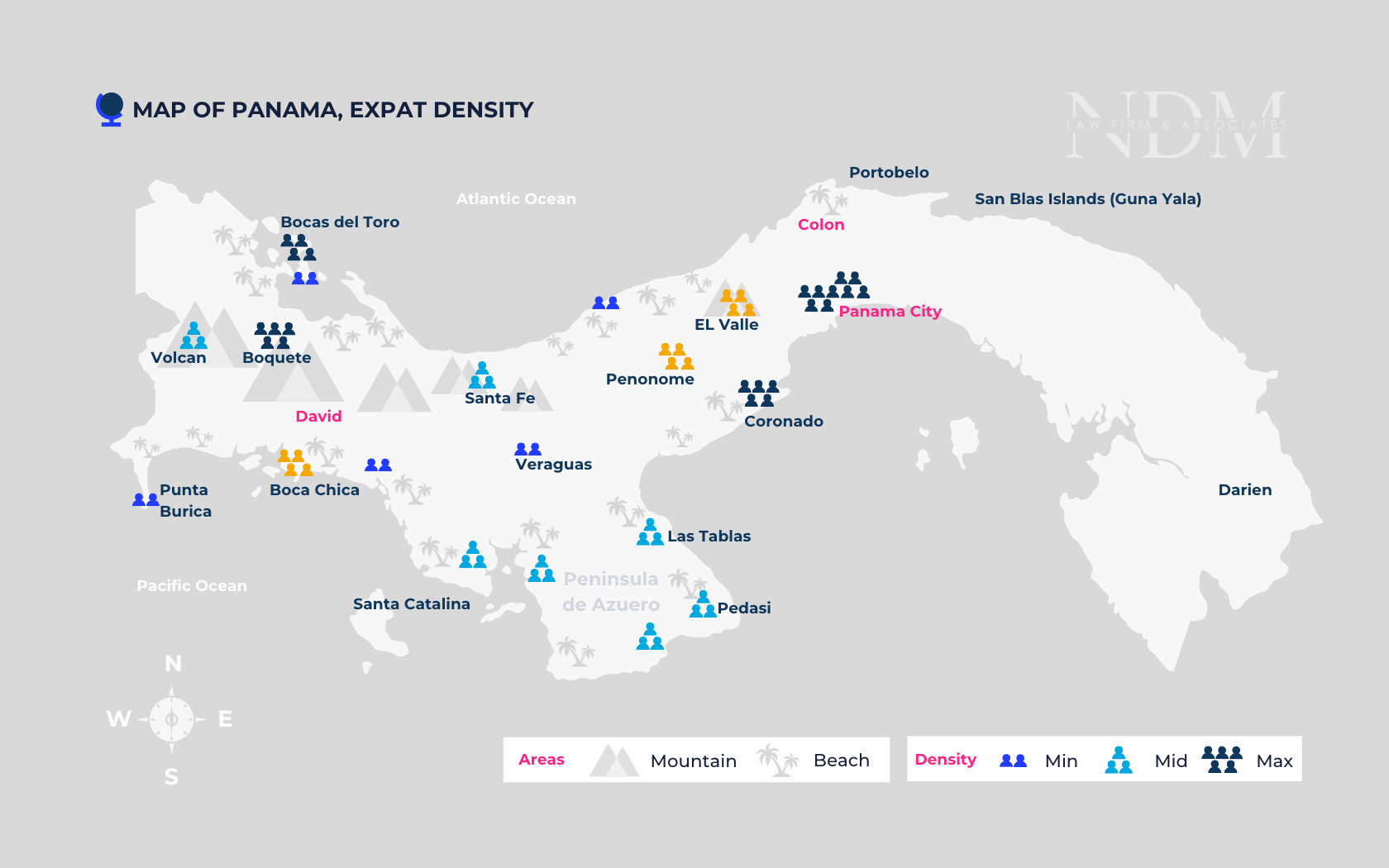
Most Americans living in Panama settle in a small number of areas, and the right one depends on climate, budget and how much Spanish you are willing to use. NDM has offices in Panama City, Boquete and Venao, so our team assists clients in person in the regions where expats actually live.
Expat Communities in Panama City
The capital offers the best hospitals, international schools and job market. El Cangrejo and San Francisco are central and walkable. Costa del Este and Punta Pacifica are newer, more expensive and popular with families and executives. Casco Viejo attracts those who want a historic setting, while Clayton and Panama Pacifico offer greener, suburban surroundings on former Canal Zone land.
Expat Communities in Coronado, Boquete and Pedasí
Coronado is the best-known Pacific beach community, about an hour and a half from the capital, with supermarkets, clinics and a large retiree population. Boquete, in the Chiriquí highlands, offers a cooler mountain climate and one of the most organized expat communities in the country. Pedasí and the Azuero coast suit those who prefer a quieter beach town and a slower pace.
Our guides to Coronado and Boquete describe each area in more detail, including what to review before you rent or buy.
Cost of Living in Panama
The cost of living in Panama depends almost entirely on location and lifestyle. Published 2026 estimates place a couple’s monthly budget in Panama City between $2,000 and $3,000 including rent, and between $1,500 and $2,000 in smaller towns of the interior. A one-bedroom apartment in the capital typically rents for $900 to $1,250 per month.
Imported goods, private schools and air conditioning are the items that raise a budget quickly. Local produce, public transport and domestic services cost considerably less than in the United States.
Residency status also affects what living in Panama costs you. Holders of the Pensionado Visa are entitled by law to discounts that include 25% on restaurant bills, 25% on airfare, 20% on private medical consultations and 50% on entertainment. These benefits require a permanent resident ID, which is one more reason to regularize your status early.
Is Panama Safe to Live In?
Panama is one of the more stable countries in the region, and most incidents that affect expats involve petty theft. As in any country, some neighborhoods and border areas call for extra caution, so we recommend reading the current US Department of State information for Panama before choosing where to live.
Legal safety matters as much as personal safety when living in Panama. Foreigners are expected to carry identification, which means your passport with a valid entry stamp or your residency card. Renting with a written contract, buying only titled property and keeping your immigration status current will prevent most of the problems we are asked to solve.
Healthcare in Panama for Expats
Private healthcare is one of the main reasons retirees choose Panama. Hospitals in Panama City are modern, many physicians trained in the United States, and a private consultation generally costs between $20 and $60. Most expats rely on private health insurance or pay out of pocket.
Two points are worth knowing before living in Panama as a retiree. Medicare does not cover care received outside the United States, so it cannot replace a local or international policy. In addition, the public system (Caja de Seguro Social) is funded through payroll contributions, so access is linked to formal employment in Panama and not to residency alone.
Expat Immigration in Panama: Your Legal Options
Living in Panama long term requires a residency permit granted by the National Immigration Service. The correct category depends on three questions: where your income comes from, whether you intend to work locally, and how much you plan to invest. For most Americans the answer is one of the options below.
How Long Can Americans Stay in Panama Without a Visa?
Up to 180 days. You will need a passport valid for at least three months beyond your entry date, a return or onward ticket, and proof of at least $500 in funds. The period written on your entry stamp is the one that governs your stay.
Leaving and re-entering to restart the clock is common, but readmission is never guaranteed and it does not create any right to residency. Remote workers who need more time can consider the Digital Nomad Visa, which requires foreign-source income of at least $36,000 per year and grants nine months, renewable once. It does not lead to permanent residency.
Pensionado Visa for Retirees
The Pensionado Visa grants permanent residency from approval. It requires a lifetime pension of at least $1,000 per month, plus $250 for each dependent. The threshold is reduced to $750 if you own property in Panama worth $100,000 or more. US Social Security, military and government pensions qualify, while rental or investment income does not.
Its main limitation is employment. A pensionado cannot work as a salaried employee for a local company, although remote work for a foreign employer and dividends from a Panamanian company are permitted.
Friendly Nations Visa for Workers and Investors
The Friendly Nations Visa is available to citizens of the United States, Canada and some fifty other countries. You qualify through an employment contract with a Panamanian company, a real estate purchase of at least $200,000, or a fixed-term bank deposit of $200,000 held for three years. It grants a two-year provisional residency and then permanent residency.
For Americans who plan on living in Panama and taking a local job, this is usually the most direct route, because the employment option connects the residency with its corresponding work permit.
Qualified Investor Visa After Decree 17 of 2026
The Qualified Investor Visa grants permanent residency in a single step. Executive Decree 17 of September 2026 changed its thresholds: $300,000 now applies only to new properties bought on first sale, resale properties require $500,000, and the investment must be held for five years. Bank deposit and securities options remain available at higher amounts. We explain the transition rules in our summary of the 2026 changes.
Once you hold permanent residency under any category, living in Panama becomes simpler. You can apply for the permanent resident ID card, and after five years you may be eligible for citizenship.
Working While Living in Panama: Visa First, Work Permit Second
This is the most misunderstood part of living in Panama. The country does not issue a work visa that lets you enter and start a job. Two separate authorities are involved: the National Immigration Service decides whether you may reside here, and the Ministry of Labor (MITRADEL) decides whether you may work. Working on tourist status exposes both the employee and the employer to fines, and the employee to deportation.
Professional Visa vs. Work Permit: What Is the Difference?
The professional visa is an immigration category. It is designed for foreigners who hold a university degree in a profession that Panamanian law does not reserve for its citizens. It requires an apostilled degree, grants a two-year provisional residency and then leads to permanent residency. It answers one question: may you live in Panama?
The professional work permit is a labor authorization issued by MITRADEL. It answers a different question: may you be employed in Panama? The first permit is granted for two years and its renewal depends on your Social Security contributions and tax compliance.
You need both. Residency without a work permit does not authorize employment, and a work permit cannot exist without the residency that supports it.
Can You Apply for a Work Permit Without a Visa?
No. MITRADEL only accepts a work permit application when your residency has been granted or is formally in process. The file must include a certificate of your immigration status and a copy of your residency card, whether approved or in process. A passport with a tourist stamp does not meet that requirement.
The correct order is therefore to file the residency application, receive the in-process card, and then file the work permit. MITRADEL usually takes one to three months, in addition to the residency timeline, so a start date should be agreed with the employer accordingly.
What If the Professional Visa Does Not Apply to You?
Law, medicine, nursing, dentistry, engineering, architecture, accounting and psychology are among the professions reserved for Panamanian citizens. If yours is on that list, or if you do not hold a university degree, the professional visa is not available. These are the alternatives:
- Friendly Nations Visa through employment. A job offer from a Panamanian company supports both the residency and its work permit.
- Labor Code quota permits. An employer may hire foreigners for up to 10% of its ordinary staff and up to 15% of its specialized or technical staff.
- Marriage to a Panamanian citizen. Residency by marriage gives access to the work permit with the broadest rights.
- Remote work for a foreign employer. The Digital Nomad Visa covers this situation and does not require a MITRADEL permit.
- Special regimes. Panama Pacifico, the City of Knowledge and the multinational headquarters regime (SEM) have their own work authorizations.
- Your own company. A foreigner may own a Panamanian corporation and receive dividends, which is different from being employed by it.
Each option has different costs, timelines and consequences for your family. Contact our immigration team before you accept a job offer, so the residency and the work permit are filed in the right order.
Property, Driving and Taxes When Living in Panama
Three everyday matters change the moment you stop being a visitor. Each one has a rule that Americans tend to discover late, usually when a deadline has already passed.
Buying Property as a Foreigner
Foreigners can buy and hold titled property in Panama with the same rights as citizens. The constitutional exception covers land within ten kilometers of the national borders. The real risk lies elsewhere: untitled land held under rights of possession, undisclosed liens and developers without the required permits.
A title search at the Public Registry and a review of the promise-to-purchase contract should take place before any deposit is paid. If the purchase is also meant to support a residency application, the property must meet the value and registration requirements of that visa.
Driving in Panama With a US License
You may drive with your US license for 90 days from each entry. This period is independent of your 180-day tourist stay, so many Americans living in Panama drive without a valid license for months without realizing it. Once you file for residency, you need a Panama driver’s license, which is obtained by validating your US license and does not normally require a new driving test.
Taxes for Americans Living in Panama
Panama applies a territorial system, so income earned outside the country is generally not taxed here. Income from Panamanian sources is taxed at 0% up to $11,000 per year, 15% up to $50,000 and 25% above that amount. The United States, however, taxes its citizens wherever they live. You will continue to file a federal return, and the IRS rules for citizens abroad determine which exclusions and credits apply. We recommend coordinating your Panamanian attorney with a US tax adviser.
How to Start Living in Panama Legally
Living in Panama legally follows a clear sequence, and the order matters because several documents expire within months.
- Define your purpose: retirement, employment, investment or remote work. This determines the residency category.
- Gather your documents in the United States: an apostilled FBI background check, pension or income letters, and marriage and birth certificates for your dependents.
- Travel to Panama and file the residency application through a licensed attorney. You will receive a temporary card while the file is processed.
- If you are going to work, file the work permit with MITRADEL once the residency is in process.
- Complete the practical steps: bank account, driver’s license, lease or purchase contract, and your permanent resident ID.
NDM Law Firm & Associates handles each of these steps for American clients from our offices in Panama City, Boquete and Venao. If you are serious about living in Panama, schedule a consultation with our immigration attorneys. We will confirm which category applies to you, what it costs and how long it takes before you make any commitment.
