


Choosing Panama vs Costa Rica for retirement is one of the happiest decisions you can face, because there is no wrong answer, only the one that fits your budget and lifestyle. Both sit at the top of every Latin America retirement list, and Panama took the number one spot in International Living’s 2025 Global Retirement Index. This 2026 guide from the immigration attorneys at NDM Law Firm & Associates compares the two on cost, healthcare, visas, weather, and the best places to live. If Panama is looking like your answer, book a free consultation and we will map out your residency.
We will give you the short verdict first, then go deep on the numbers so you can decide with confidence.
Panama vs Costa Rica for Retirement: The Quick Answer
If you want the headline before the detail: Panama is usually the more affordable choice and runs on the US dollar, while Costa Rica offers a celebrated public healthcare system and unmatched nature. Here is the side-by-side at a glance.
| Category | Panama | Costa Rica |
| Monthly budget (couple) | About US$2,200 to $2,800 | About US$2,800 to $3,500 |
| Currency | US dollar (no exchange risk) | Costa Rican colon (mild currency risk) |
| Healthcare | Good private care, best in Panama City | Excellent public Caja plus private |
| Retirement visa income | US$1,000 per month pension | US$1,000 per month pension (or Rentista / Inversionista) |
| Retiree discounts | Very generous (up to 25% off many services) | Real but more modest |
| Residency speed | Fast, permanent in about 3 to 6 months | Slower, 6 to 18 months, renew until permanent |
| Best for | Value, modern amenities, a dollar economy | Nature, public healthcare, pura vida |

Which Country Is Cheaper for Retirees?
Panama is generally the cheaper of the two. Most cost surveys put a comfortable couple’s budget in Panama at roughly US$2,200 to $2,800 per month, against about US$2,800 to $3,500 in Costa Rica, with one widely cited comparison finding Costa Rica around 11.5% more expensive overall. The gap is largest in housing and healthcare and smallest if you choose a popular beach town in either country. Because Panama uses the US dollar, Americans also avoid the currency risk that comes with Costa Rica’s colon.
Which Wins on Healthcare, Safety, and Lifestyle?
Costa Rica is the usual winner on public healthcare thanks to its universal Caja system, and it is famous for the pura vida lifestyle and world-class nature. Panama counters with excellent, very affordable private care in the capital, modern infrastructure, and the most generous retiree discount program in the region. Both are among the safer countries in Central America and are politically stable, so the honest answer is that this comes down to your priorities rather than a clear knockout.
Sample Monthly Retirement Budgets
Here is a realistic breakdown for a couple living comfortably but not extravagantly in each country in 2026. Treat these as planning ranges, not quotes, since your spending will depend on the town and your habits.
| Monthly expense (couple) | Panama | Costa Rica |
| Rent, furnished 1 to 2 bedroom | US$800 to $1,500 | US$1,000 to $1,800 |
| Groceries | US$300 to $450 | US$400 to $550 |
| Utilities and internet | US$100 to $250 | US$120 to $280 |
| Private health insurance | US$200 to $400 | US$150 to $350 (plus Caja) |
| Comfortable monthly total | About US$2,200 to $2,800 | About US$2,800 to $3,500 |
Housing and Real Estate Costs
Housing is where Panama pulls ahead, because land is cheaper and much of the new construction is aimed at the expat market. A furnished one-bedroom in a good Panama City neighborhood runs around US$800 to $1,200, and across the country there are desirable rentals from US$550 to $1,000. In Costa Rica, comparable rentals in the Central Valley or a beach town tend to run higher. Foreigners can own titled property outright in both countries, and many retirees rent for six to twelve months before buying to be sure a town fits.
Groceries, Utilities, and Everyday Expenses
Day-to-day costs favor Panama modestly. Local produce, domestic help, and dining out are affordable in both countries, while imported goods carry a markup everywhere in the region, more so in Costa Rica. Electricity can be the surprise line item in Panama’s lowlands because of air conditioning, which is one more reason many retirees choose the naturally cool highlands where you rarely need it.
Healthcare in Panama vs Costa Rica
Healthcare is often the deciding factor, and both countries deliver quality care at a fraction of US prices. The difference is in the model: Costa Rica leans on a strong public system, while Panama leans on affordable private care.
Healthcare in Panama: Public and Private
Panama runs a public system alongside a well-regarded private one. Retirees overwhelmingly use private care, which is excellent and inexpensive by US standards, and the best hospitals are in Panama City, including a facility affiliated with Johns Hopkins Medicine. Private health insurance for retirees typically runs about US$200 to $400 per month depending on age and coverage. The one caveat is location: care quality drops outside the capital, so if you retire to a beach town, plan to travel to Panama City for anything serious.
Costa Rica’s Caja and Private Care
Costa Rica’s universal public system, the Caja Costarricense de Seguro Social, is open to all legal residents for an income-based monthly contribution, often around US$80 to $150. It covers everything from checkups to major surgery, though non-emergency wait times can be long. Many expats pair the Caja with private care or a discount program for faster specialist access, and private appointments remain far cheaper than in the United States. Residency in Costa Rica requires enrolling in the Caja, so budget that contribution.
Insurance, Medicare, and What Retirees Should Know
One rule applies to both countries: US Medicare does not cover you abroad. American retirees either self-insure, buy private local or international coverage, or use the public system where eligible. A useful way to think about it is total exposure: a global insurance plan may cost a few thousand dollars a year but cap your risk, while paying cash works for routine care because prices are low. Weigh your own health and risk tolerance, and get quotes before you move.
Retirement Visas: Panama Pensionado vs Costa Rica Options
This is where the two countries feel most different, and where Panama’s famous program shines. Both welcome retirees, but the requirements, speed, and perks vary. Our team handles the Panama side end to end, so book a consultation if you want the fastest route to residency.
The Panama Pensionado Visa and Its Discounts
Panama’s Pensionado Visa is widely considered one of the best retirement programs in the world. You qualify by proving a lifetime pension of at least US$1,000 per month, plus US$250 per month for a dependent, and it grants permanent residency right away. What sets it apart is the discount package, which is used every day rather than once: commonly around 25% off flights and entertainment, 15 to 25% off medical bills, and reductions on restaurants, utilities, and more. For a US retiree with Social Security or a private pension, it is often the simplest and most rewarding path to living in Panama.
Costa Rica’s Pensionado, Rentista, and Inversionista Visas
Costa Rica offers three main routes. The Pensionado requires US$1,000 per month in pension income. The Rentista suits those without a pension, requiring a deposit of US$60,000 or proof of US$2,500 per month in stable income for two years. The Inversionista is for investors placing about US$150,000 in real estate or other approved options. Costa Rica has its own retiree discounts on utilities, hotels, and flights, though they are generally more modest than Panama’s.
Cost and Timeline to Get Your Residency
Speed is a real difference. In Panama, the process is lawyer-filed and fast: many retirees leave immigration with a temporary card quickly and receive permanent status in roughly three to six months. In Costa Rica, you enroll with immigration, pay official fees, and typically renew every two years until you qualify for permanent status, with the overall process often taking six to eighteen months. Beyond government fees, budget for legal fees, document apostille, and translation in either country.
Best Places to Retire in Panama
Panama packs a lot of variety into a small country, from cool mountain towns to Caribbean islands. These are the areas retirees gravitate to, and each has a distinct feel and budget.
Boquete and the Cool Highlands
Boquete, in the Chiriqui highlands near Volcan Baru, is the perennial favorite. It offers spring-like weather year-round, coffee farms and mountain views, and one of the largest, most established expat communities in the country, which makes settling in easy. Nearby David is the regional hub for shopping, banking, and hospitals, and the smaller towns of Volcan and El Valle de Anton offer the same cool climate at an even gentler pace. NDM has an office in Boquete, so we know the area well.
Coronado and the Pacific Beach Towns
If you want sand rather than mountains, Coronado is the best-known beach community, close enough to Panama City for a day trip and full of amenities and fellow expats. Further along the Pacific coast, the Pedasi and Venao area on the Azuero Peninsula draws a laid-back, surf-friendly crowd, and it is another part of the country where NDM has a presence.

Panama City, Bocas del Toro, and the Azuero Coast
Panama City suits retirees who want urban energy, top hospitals, international dining, and direct flights home, all at prices below major US metros. For something completely different, Bocas del Toro offers funky Caribbean island living, while the broader Azuero Peninsula gives you traditional towns and quiet beaches. Between the highlands, the city, and two coasts, most retirees can find a version of Panama that fits.
Best Places to Retire in Costa Rica
Costa Rica’s draw is nature and a gentle pace, and its retirement hubs split neatly between the temperate Central Valley and the Pacific beaches.
The Central Valley: Atenas, Grecia, and Escazu
The Central Valley is the most popular landing spot, prized for mild, spring-like temperatures and easy access to San Jose’s international airport and hospitals. Towns such as Atenas and Grecia are known for their climate and welcoming expat communities, while Escazu and Santa Ana offer a more upscale, convenient suburban feel. It is an easy first base for anyone nervous about a big leap.
Pacific Coast Beach Towns
For beach life, the Guanacaste and Nicoya areas are the headline choices. Tamarindo and Nosara pair surf and sand with enough infrastructure and English-speaking services to feel comfortable, while Santa Teresa leans bohemian. The trade-off is cost, since popular coastal towns are among the more expensive places to live in the country.
Weather and Climate: Panama vs Costa Rica
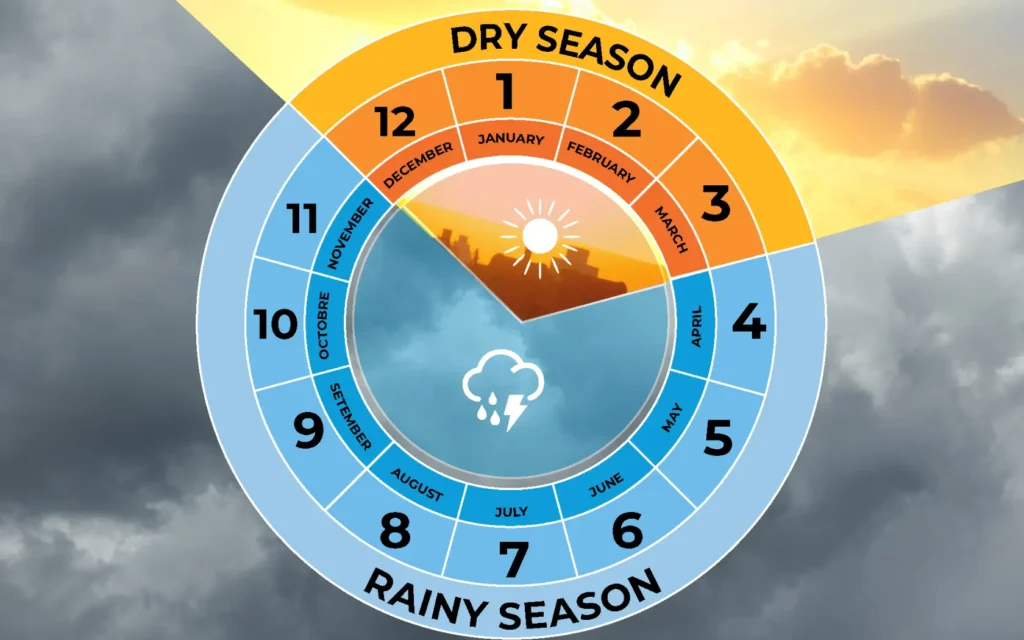
Both countries are tropical, with a dry season and a green, rainy season, but the day-to-day feel depends entirely on elevation and coast.
Panama’s Tropical Lowlands and Highland Escape
Panama is warm year-round with a dry season from roughly December to April and a rainy season the rest of the year. The lowlands and coasts are hot and humid, which some retirees from cooler climates find too much. The fix is elevation: highland towns like Boquete, Volcan, and El Valle sit around ten to fifteen degrees cooler and rarely need air conditioning. Panama also sits outside the hurricane belt, a quiet but meaningful advantage.
Costa Rica’s Microclimates
Costa Rica is a country of microclimates. The Central Valley and the Arenal area enjoy a consistent spring-like climate, Guanacaste on the northern Pacific is the driest region, and the Caribbean side is greener and wetter. This variety means you can often find your ideal weather within a short drive, which is part of the country’s appeal.
Taxes for Retirees in Panama and Costa Rica
Good news on tax: both countries use a territorial system, which is friendly to retirees living on foreign income. Still, the details matter, and this is general information rather than tax advice.
How Each Country Taxes Foreign Retirement Income
Panama generally does not tax income earned outside the country, so foreign pensions, Social Security, and most overseas income fall outside Panamanian tax. You are considered a Panamanian tax resident if you spend more than 183 days a year there or have significant ties. Costa Rica similarly taxes local-source income and generally leaves foreign pensions alone. In both cases, the local system rarely touches a typical retiree’s pension.
What US and Canadian Retirees Should Know
Moving abroad does not end your home-country filing obligations. US citizens must still file a federal return and report worldwide income to the IRS regardless of where they live, and Canadians should review their residency and pension rules. UK retirees should note that the UK state pension is often frozen in these countries rather than uprated. Confirm your specific situation with a cross-border tax professional before you rely on any of this.
The Downsides: Risks and Regrets to Weigh First
Every honest retirement guide should cover the hard parts, and searching for the downsides is smart, not pessimistic. Here is what people most often struggle with in each country.
Common Challenges of Retiring in Panama
The most common complaints about Panama are the heat and humidity in the lowlands, heavy rain and occasional flooding in the wet season, and healthcare quality that thins out away from Panama City. English is common in expat hubs but not everywhere, so some Spanish helps. Bureaucracy can be slow, and Panama City has real traffic and rising prices. None of these are dealbreakers, and most are solved by choosing the right town, but you should go in with clear eyes.
Drawbacks of Retiring in Costa Rica
Costa Rica’s biggest drawback is cost, since it is among the pricier countries in the region and imported goods carry steep markups. The colon adds mild currency risk for anyone paid in dollars. Caja wait times for non-urgent care can be long, the famously relaxed pace can mean slow service and paperwork, and popular beach towns can feel crowded in high season. As in Panama, the rainy season is genuinely rainy.
Panama vs Costa Rica: Which Should You Choose?
There is no universal winner, only the better fit for you. Use this simple framework to point yourself in the right direction, then visit before you commit.
Retire in Panama If…
- You want the lowest comfortable cost and the security of a US-dollar economy.
- You value modern infrastructure, top city hospitals, and direct flights home.
- The generous Pensionado discounts and a fast, permanent residency appeal to you.
- You like the idea of cool highland towns like Boquete or beach living at Coronado.
Retire in Costa Rica If…
- Nature, biodiversity, and the pura vida pace are your top priorities.
- A strong public healthcare system matters more to you than saving every dollar.
- You are drawn to the Central Valley’s spring-like climate or Guanacaste’s beaches.
- You do not mind a somewhat higher budget and a slower bureaucracy.
Why Retire in Panama With NDM Law Firm
If your comparison of Panama vs Costa Rica for retirement is leaning toward Panama, the move is far smoother with a local firm handling the paperwork. NDM Law Firm & Associates guides retirees from their first scouting trip through permanent residency and beyond.
What Our Panama Immigration Lawyers Handle
We manage the whole process: confirming you qualify for the Pensionado or another visa, preparing and apostilling documents, coordinating Spanish translations, filing before the National Migration Service, and following through to your permanent residency card. Our team works in English and Spanish, so nothing is lost between you and the authorities, and we keep you updated at every step.
Offices in Panama City, Boquete, and Venao
With offices in Panama City, Boquete, and Venao, we are on the ground in the very places retirees choose to live, from the capital to the highlands to the coast. That local presence makes filings, biometrics, and in-person steps far easier than working with a firm that only exists online.
